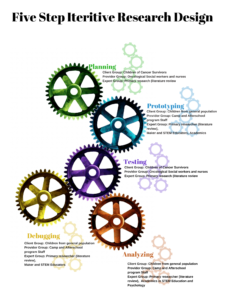
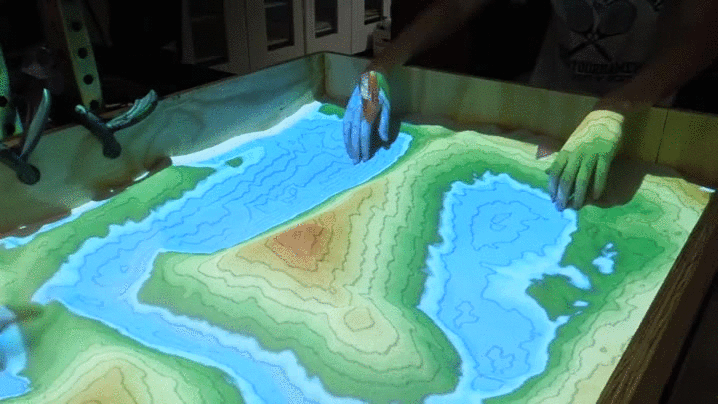
The first cycle in The Wellbotics Process is Mapping. During this cycle, we do more than plan. We take an approach to Mapping directly from cartographers who carefully survey existing terrain, even if it is unexplored territory, with an attention and accountability to detail that is not always part of a traditional planning process. Mapping not only provides us with direction but also creates context, scale, and relevance. In an ordinary world, Mapping results in a physical product in the form of a topographical or other specialized map while Wellbotics maps the terrain of trauma, scaled for the users to experience through robots. The presence of a three-dimensional object greatly impacts the experience.
Our initial phase is a graphical map, often a 3D model, not simply a plan. And, according to Dr. Davis, this cycle shares elements with the design process of not just cartography but also mind mapping and user experience (UX) design. While cartography marries science with art to represent environments, mind mapping allows ideas to be connected and visually organized. And, of course, both cartography and mind mapping are designed with the user experience in mind, so that users can interact with the results, not just be witness to or blindly follow them. (My navigation system once told me to turn left while I was in the middle of driving over a bridge. I said no. And yes, I talk back to my GPS, but that’s another story.)
https://giphy.com/gifs/reality-sandbox-AOcLLCOl2w1oI
Cartography has been defined by the International Cartographic Association as “the discipline dealing with the conception, production, dissemination and study of maps.” And, according to the Department of Geography at Pennsylvania State University’s College of Earth and Mineral Sciences, we can think of cartography as a process that connects the map makers with users as well as the environment that is being mapped in addition to the map itself.
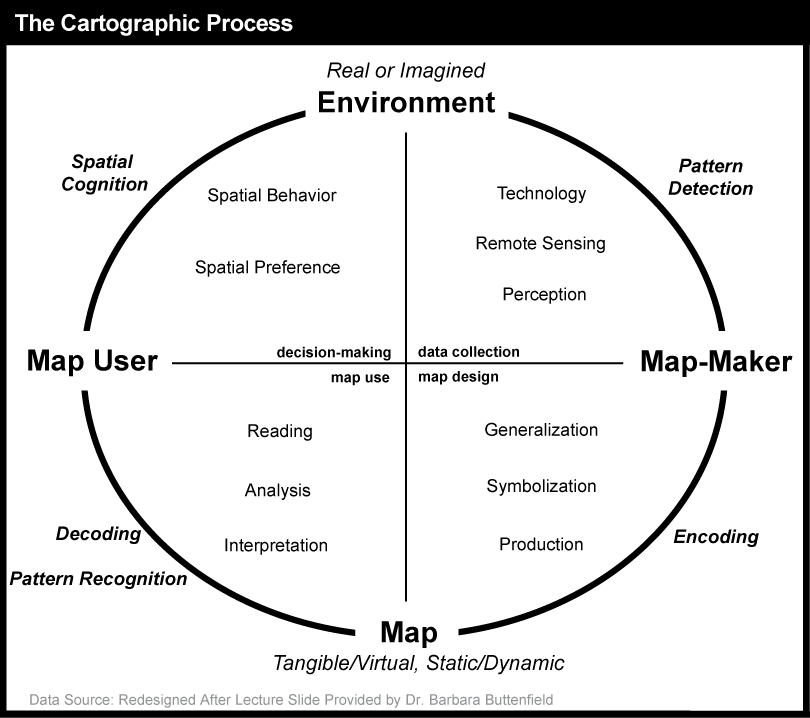
https://www.e-education.psu.edu/geog160/node/1882
As V. Krishna Kumar Ph.D. writes in Psychology Today, “Mind Mapping is a multi-purpose tool for note-taking in meetings and classes, analyzing study materials for better retention and comprehension, brainstorming ideas for event planning, problem-solving, decision-making, presentations, writing, research, and development.” And, according to the Center for Instructional Technology & Training at the University of Florida, mind maps “blend creativity and logic” and “prompt learners to think critically and to create illustrations of relationships in a visual-spatial representation” with a structure that resembles that of the connections between neurons in the brain.
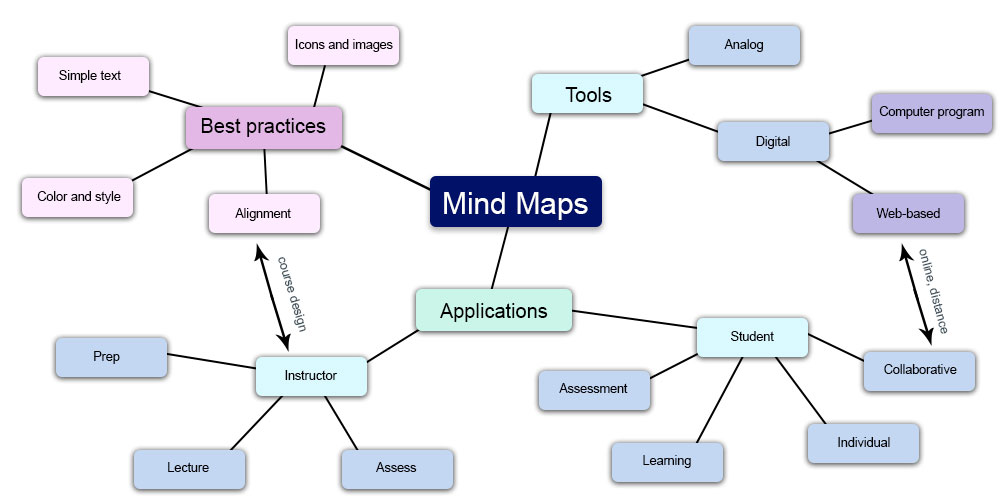
http://citt.ufl.edu/tools/mind-maps/
User experience (UX) is the realm of designers that, according to Ian Johnson at Harbour.Space, “are the digital cartographers of the 21st century.” And he envisions the user experience design process as involving the following steps:
- Comprehension
- Research
- UX Guidelines
- Latest Trends
- Competition
- Sketch It
- Design It
- Build It
- Analyze and Test
The concept that Dr. Davis developed contains elements that are similar to that of these three processes and has resulted in the Mapping cycle as it exists in its current state. This cycle in turn contributes to The Wellbotics Process as a whole, which helps kids and families to process trauma in addition to a range of other applications.
This is the second in a series of articles on The Wellbotics Process. Check back with us for the next article which will provide some insight about the Prototyping cycle. And in the meantime, if you haven’t already, follow us on Facebook, Twitter, LinkedIn, and Instagram for more news from the Wellbotics team. And don’t turn left if you’re in the middle of a bridge, even if your GPS system tells you to.
Maria Class
Wellbotics Team Leader and Curator